
Disclosure: CreditMaze is an independent, advertiser-supported website. Some of the offers that appear on this site are from companies that compensate us. This compensation may impact how and where products appear (including the order in which they appear), but it does not influence our editorial opinions or ratings. Our goal is to provide accurate, unbiased information to help you make smarter financial decisions.
Your credit card statement is one of the most important financial documents you receive every month — yet most people barely glance at it. Understanding every section of your statement helps you spot unauthorized charges, avoid unnecessary fees, minimize interest costs, and make smarter decisions about paying down your balance.
This line-by-line guide explains what each section of your credit card statement means, what to watch for, and how to use this information to your advantage.
Anatomy of a Credit Card Statement
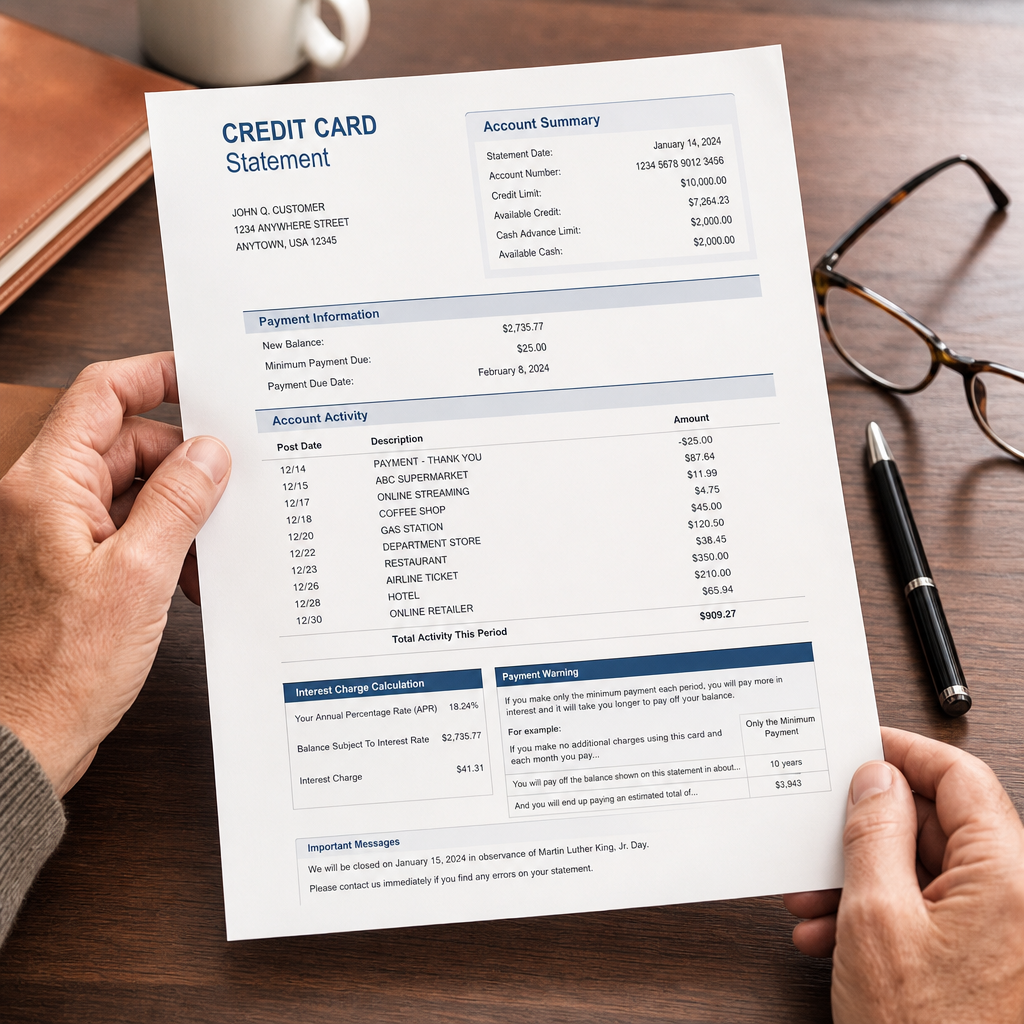
While formatting varies by issuer, every credit card statement contains the same core sections required by the Credit CARD Act of 2009. Here’s what you’ll find and why it matters:
1. Account Summary
The account summary sits at the top of your statement and gives you a high-level snapshot of your account.
| Field | What It Means | Why It Matters |
|---|---|---|
| Previous Balance | Your balance at the end of the last billing cycle | Starting point for this month’s charges |
| Payments & Credits | Total payments made and credits received | Confirms your payments were processed |
| New Charges | Purchases, cash advances, and fees this cycle | Shows total new spending to review |
| Interest Charged | Interest accrued on carried balances | The cost of carrying debt this month |
| New Balance | Previous balance + charges + interest − payments | What you currently owe |
| Credit Limit | Maximum amount you can charge | Key for tracking your credit utilization |
| Available Credit | Credit limit minus current balance | How much room you have left |
2. Payment Information
This section tells you what you owe and when it’s due. It contains three critical numbers:
Minimum Payment Due
The smallest amount you can pay to keep your account in good standing. This is typically the greater of a flat amount ($25–$35) or 1%–3% of your total balance plus fees and interest. Important: Paying only the minimum is extremely expensive over time.
Statement Balance
The full amount you owe as of the statement closing date. Paying this amount in full by the due date means you pay zero interest on purchases — this is how the grace period works.
Payment Due Date
The date your payment must be received (not mailed) to avoid late fees. Under the CARD Act, your due date must be the same day each month, and payments received before 5:00 PM on the due date are considered on time.
⚠️ Critical: Your statement also includes a “Minimum Payment Warning” box showing how long it would take to pay off your balance making only minimum payments vs. paying a fixed higher amount. If your warning shows it would take 15+ years to pay off your balance, that’s a strong signal to review strategies for getting out of credit card debt.
3. Transaction Details
This is the longest section of your statement, listing every transaction during the billing period. Each entry typically shows:
- Transaction date: When you made the purchase
- Post date: When the transaction was processed (may differ by 1–3 days)
- Description: Merchant name and location
- Reference number: Unique ID for disputes
- Amount: What was charged
- Category code: How the purchase was classified (affects rewards earning)
What to Look For
- Unrecognized charges: Even small ones ($1–$5) may be test charges from stolen card data
- Duplicate charges: The same merchant charging the same amount twice
- Subscription charges: Services you forgot to cancel
- Incorrect amounts: Charges that don’t match your receipts
- Merchant name discrepancies: Some merchants process under different names than their storefront
💡 Pro Tip: Review your transactions within 60 days to preserve your full dispute rights under the Fair Credit Billing Act. After 60 days, your issuer may not be obligated to investigate unauthorized charges. Set a calendar reminder to review your statement as soon as it posts.
4. Fees Charged
This section itemizes any fees assessed during the billing period. Common fees include:
| Fee Type | Typical Amount | How to Avoid It |
|---|---|---|
| Late Payment Fee | Up to $41 | Set up autopay for at least the minimum |
| Annual Fee | $0–$695 | Choose no-annual-fee cards or earn rewards that offset the fee |
| Cash Advance Fee | 3%–5% (min $10) | Avoid cash advances entirely — interest starts immediately |
| Foreign Transaction Fee | 1%–3% | Use a no-foreign-fee card for international purchases |
| Balance Transfer Fee | 3%–5% | Factor into cost calculation when considering a balance transfer |
| Returned Payment Fee | Up to $41 | Ensure sufficient funds before payment processes |
5. Interest Charges
This section breaks down exactly how much interest you paid and how it was calculated. It includes:
APR (Annual Percentage Rate)
Your card may have multiple APRs:
- Purchase APR: Rate on regular purchases (typically 18%–29%)
- Cash Advance APR: Higher rate for cash withdrawals (typically 25%–30%)
- Penalty APR: Even higher rate triggered by late payments (up to 29.99%)
- Balance Transfer APR: Rate on transferred balances (may be promotional 0%)
How Interest Is Calculated
Credit card interest uses the average daily balance method. Your issuer adds up your balance at the end of each day in the billing cycle, divides by the number of days, and multiplies by the daily periodic rate (APR ÷ 365).
Key insight: Interest compounds daily, not monthly. That means a 24% APR actually costs more than 24% annually due to compounding. The effective annual rate on a 24% APR card is approximately 26.8%.
The Grace Period
If you pay your statement balance in full by the due date, you get a grace period on new purchases — meaning no interest is charged. But if you carry any balance, the grace period is lost and interest accrues on all purchases from the date they post. This is why paying in full every month is so important.
6. Rewards Summary
If you have a rewards card, your statement may include a summary of points, miles, or cash back earned this period plus your total accumulated rewards balance. If you’re not maximizing your rewards, check out our guide on building a credit card rewards strategy.
7. Important Notices and Changes
Issuers are legally required to notify you of any changes to your account terms. Look for notices about:
- APR changes (rate increases require 45 days’ notice)
- Credit limit changes
- Fee changes
- Changes to rewards programs
- Upcoming promotional rate expirations
Understanding Billing Cycles and Statement Dates
Your billing cycle is the period between statement closing dates — typically 28–31 days. Understanding this cycle is crucial for managing your credit wisely:
Key Dates in Your Billing Cycle
| Date | What Happens | Why It Matters |
|---|---|---|
| Billing cycle start | New charges begin accumulating | Charges from this point forward appear on the next statement |
| Statement closing date | Statement is generated, balance is reported | This balance is what credit bureaus see; pay before this date to lower reported utilization |
| Payment due date | Minimum payment must be received | Typically 21–25 days after statement closing date; this is your grace period |
The Grace Period Window
The grace period is the time between your statement closing date and your payment due date — at least 21 days by law. During this window, no interest accrues on new purchases (assuming you paid last month’s balance in full). This is why paying in full each month is so valuable: you’re essentially getting a free short-term loan on every purchase.
What the Minimum Payment Warning Really Means
Federal law requires your statement to include a table showing the cost of minimum payments versus a fixed higher amount. For example, on a $5,000 balance at 22% APR, making only minimum payments would take approximately 22 years and cost over $8,400 in interest. Paying $189 per month instead would clear the balance in 3 years with $1,808 in interest — saving you over $6,600.
If these numbers look alarming for your balance, explore our guide on how to get out of credit card debt for actionable strategies.
Digital Statement Tools and Alerts
Most card issuers now offer digital tools that go beyond the paper statement:
- Real-time transaction alerts: Get push notifications for every purchase — the fastest way to catch unauthorized charges
- Spending categorization: See where your money goes with automatic category breakdowns (dining, groceries, travel, entertainment)
- Year-end summaries: Annual spending reports useful for budgeting and tax preparation
- Custom alerts: Set notifications for when you approach your credit limit, when a payment is due, or when a large purchase posts
- Paperless statements: Environmentally friendly and easier to search — just make sure you review them monthly rather than ignoring digital notifications
How to Use Your Statement Strategically
Track Your Credit Utilization
Your statement balance is typically what gets reported to the credit bureaus. If your statement balance shows high utilization (above 30% of your credit limit), it could be hurting your credit score even if you pay in full by the due date. To optimize, make a payment before your statement closes to lower the reported balance. Learn more in our credit utilization guide.
Catch Fraud Early
The sooner you spot unauthorized charges, the easier they are to resolve. Federal law limits your liability to $50 for unauthorized credit card charges (and most issuers offer $0 liability), but you must report them within 60 days of the statement date.
Negotiate Fees
If you’ve been a good customer, call your issuer and ask them to waive late fees, annual fees, or even lower your APR. Many issuers will accommodate one-time requests to retain customers.
💡 Pro Tip: Set up autopay for at least the minimum payment to avoid late fees, but continue to manually review your statement each month for errors and fraud. Autopay prevents late payments; manual review prevents everything else.
Frequently Asked Questions
What’s the difference between my statement balance and current balance?
Your statement balance is what you owed on the statement closing date. Your current balance includes the statement balance plus any new charges since the statement closed. To avoid interest, you need to pay the statement balance by the due date — not necessarily the current balance.
Why doesn’t my payment show on this month’s statement?
Statements cover a specific billing period (usually about 30 days). If your payment was made after the statement closing date, it will appear on next month’s statement. Check the billing period dates at the top of your statement.
What should I do if I find an error on my statement?
Contact your card issuer immediately to dispute the charge. Under the Fair Credit Billing Act, you have 60 days from the statement date to file a dispute. Write a formal dispute letter and send it to the address listed for billing inquiries (not the payment address).
Does paying my statement balance in full really avoid all interest?
For purchases, yes — as long as you had a grace period (meaning you paid last month’s statement in full too). Cash advances and balance transfers may accrue interest from day one regardless. Always check the specific terms for each transaction type.
How often should I review my credit card statement?
Review every statement thoroughly when it arrives. For extra protection, check your online transactions weekly. This helps you catch fraud quickly and stay aware of your spending patterns.
When to Contact Your Card Issuer
Don’t hesitate to call the customer service number on your statement if you notice any of the following: charges you don’t recognize (even small test charges of $1–$5), fees that seem incorrect, interest charges when you paid in full, or any sudden changes to your APR. Most issuers have dedicated fraud teams and billing dispute departments that can resolve issues quickly — and the sooner you report problems, the stronger your consumer protections under federal law.
Bottom Line
Your credit card statement is more than a bill — it’s a financial report card that reveals your spending habits, the cost of carrying debt, and potential fraud. Take 10 minutes each month to review it carefully. Pay your statement balance in full when possible, dispute errors promptly, and use the information to make smarter decisions about your credit strategy.