
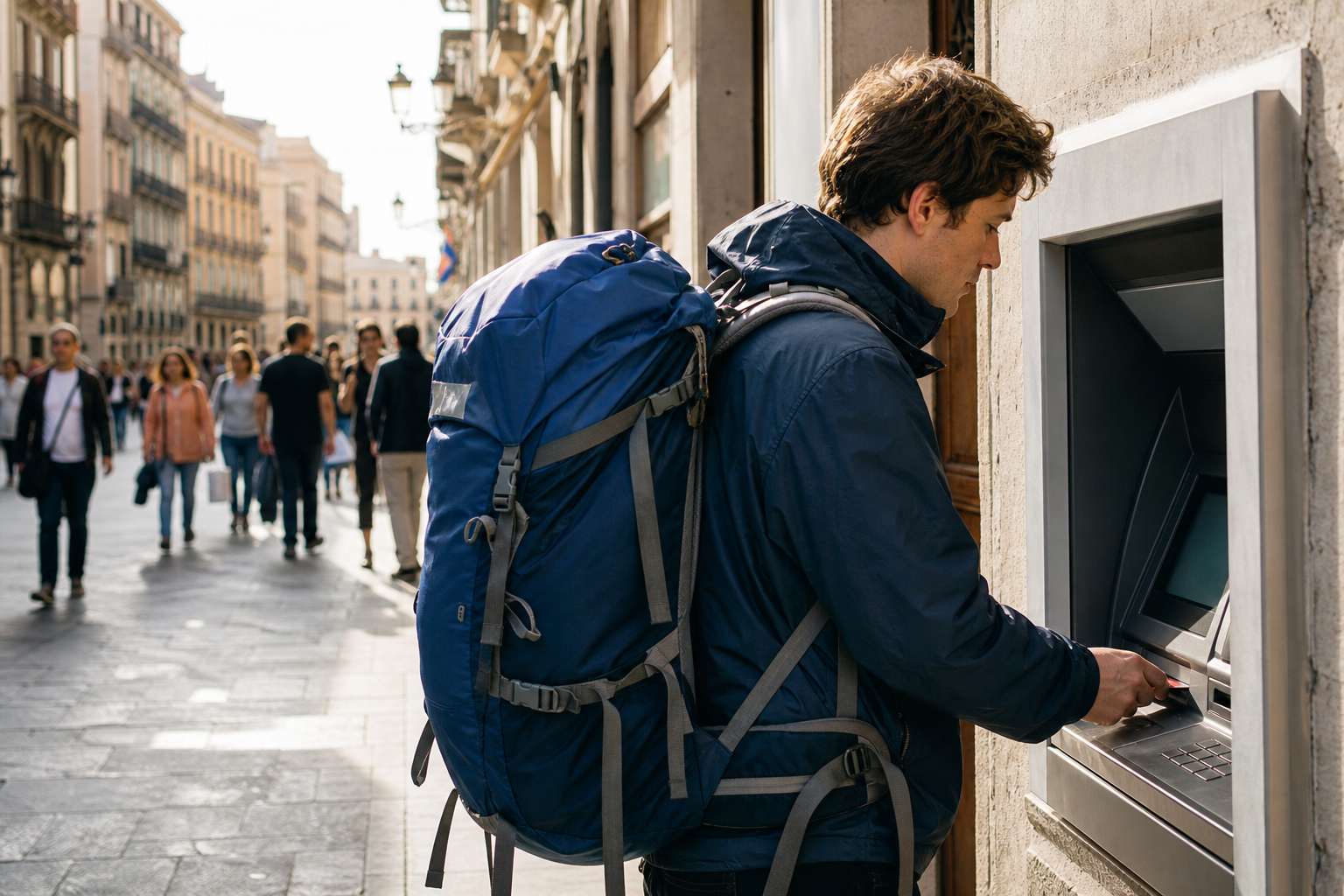
Banking works fine until you cross a border. Then the small print starts costing money: a 3% foreign transaction fee on every purchase, $5 per ATM withdrawal plus the operator’s charge, a currency conversion spread hidden in the exchange rate, a debit card frozen by fraud rules, and — for long-term expats — an account closed outright because you no longer have a U.S. residential address.
A traveler spending $4,000 abroad on a typical bank card loses roughly $120 to foreign transaction fees alone, before ATM charges and conversion markups. The right combination of accounts eliminates nearly all of it. This guide covers what to look for, how to structure accounts for short trips versus life abroad, and the traps that catch expats specifically.
Disclosure: CreditMaze may earn a commission from some financial institutions. Fees, reimbursement policies, and account eligibility rules change frequently and are set by each institution. Verify current terms before opening an account.
The five fees that matter
| Fee | Typical cost | How to avoid it |
|---|---|---|
| Foreign transaction fee | 1-3% of each purchase | Use a card that charges 0% |
| Out-of-network ATM fee | $2.50-$5 per withdrawal from your bank | Bank that rebates ATM fees worldwide |
| ATM operator surcharge | Local currency equivalent of $3-$8 | Unlimited rebate accounts refund this too |
| Currency conversion markup | 0.5-3% baked into the rate | Always decline dynamic currency conversion |
| Incoming or outgoing wire fee | $15-$50 | Multi-currency app or fee-free bank tier |
The most avoidable one is the fourth. When a terminal or ATM abroad offers to charge you “in USD,” that is dynamic currency conversion, and the exchange rate is set by the merchant’s processor at a markup. Always choose the local currency and let your card network convert it. This single habit saves more than most rewards programs earn.
What a good travel banking setup looks like
No single account does everything. The reliable structure is three layers:
- A checking account that rebates ATM fees worldwide. Online banks and several brokerage cash accounts refund both their own fee and the operator’s surcharge, with no monthly maintenance fee.
- A credit card with no foreign transaction fee for all purchases, ideally with chip-and-PIN capability for European kiosks and strong fraud protection. Our roundup of no foreign transaction fee cards covers the field.
- A backup account at a second institution, funded and carried separately. Cards get frozen, lost, and swallowed by ATMs. A single point of failure abroad is a genuine emergency.
Pro tip: Carry your two debit cards in separate places — one in your wallet, one in your luggage — and keep a small stash of local cash. The most common travel banking disaster is not fees; it is being cardless in a country where your bank’s phone line is closed for the night.
Account archetypes compared
| Type | Strengths | Limitations | Best for |
|---|---|---|---|
| Online bank with global ATM rebates | Unlimited or generous rebates, no monthly fee, decent APY | No branches, U.S. address usually required | Frequent travelers |
| Brokerage cash management account | Worldwide ATM rebates, no foreign transaction fee on debit | Requires brokerage relationship | Long trips, digital nomads |
| Credit union | Low fees, member service, some ATM alliances | Rebate caps, limited international support | Occasional travelers |
| Global bank with international presence | Branches abroad, cross-border transfers between own accounts | High balance requirements for fee waivers | Expats with significant assets |
| Multi-currency fintech account | Hold and convert currencies near interbank rates, local receiving details | Not a full bank; deposit protection differs | Getting paid in multiple currencies |
For a broader look at the U.S. side of these options, see our comparisons of online banks, credit unions, and checking accounts.
What changes when you actually move abroad
Travel banking is a fee problem. Expat banking is a compliance problem, and it is harder.
Address requirements. Most U.S. banks require a U.S. residential address, and updating your profile to a foreign address can trigger account restrictions or closure. Many expats keep a family member’s address; be aware that misrepresenting your residence violates account agreements. Institutions differ substantially in how they treat non-resident customers, so ask before you move.
FATCA and account access. Because of U.S. tax reporting rules, some foreign banks decline American customers outright, and some U.S. brokerages restrict trading for account holders resident abroad. Neither is universal, but both are common enough to check in advance.
FBAR reporting. If the combined value of your foreign financial accounts exceeds $10,000 at any point in a year, you must file an FBAR. Penalties for non-filing are severe, and the threshold is aggregate, not per account.
Two-factor authentication. Many U.S. banks send codes only to U.S. phone numbers. Keep a U.S. number active through a low-cost carrier or a number-porting service before you go, or you may be locked out of your own money.
Credit history does not travel. Your U.S. score means nothing in a new country, and you start over. Keep a U.S. card open and active to preserve your file, and expect to build local credit from scratch — the process resembles building credit as an immigrant in reverse.
Moving money across borders
Traditional wires are expensive and slow: a sending fee, a receiving fee, possible intermediary bank fees, and an exchange rate marked up well above interbank. For recurring transfers, specialist services convert at rates far closer to the true midmarket rate with transparent flat fees.
Practical rules:
- Compare total landed cost, not the advertised fee — the exchange rate is where most of the cost hides.
- For large one-time transfers such as a property purchase, get quotes from at least two providers; the spread on six figures is real money.
- Verify recipient details by phone using a number you already had, never one supplied in an email. Wire fraud in property transactions is a large and growing category — our guide to wiring money safely covers the verification process.
- Keep records; large transfers can prompt questions from either country’s tax authority.
A worked example: a two-month trip
Priya spends nine weeks across Europe and Southeast Asia. Her spending: $5,200 on cards, plus $1,800 in cash withdrawn over twelve ATM visits.
Setup A — her regular bank. A 3% foreign transaction fee on card purchases costs $156. Twelve withdrawals at $5 each cost $60, plus operator surcharges averaging $4 for another $48. She accepts “charge in USD” at several terminals, adding roughly 2% on about $1,500 of spending, or $30. Total leakage: about $294.
Setup B — a travel-ready structure. A no-foreign-transaction-fee credit card handles purchases at zero cost. A checking account rebating all ATM fees worldwide refunds both the $60 and the $48. She always chooses local currency. Total leakage: about $0, and she earns roughly $100 in card rewards on the purchases.
The gap is nearly $400 for a single trip, achieved by opening two accounts once. For someone traveling annually, or living abroad, the compounding is obvious — and it stacks with the trip-cancellation and rental coverage from a good card, which many travelers duplicate by buying separate travel insurance unnecessarily. Frequent flyers should also weigh travel rewards cards for the redemption value on top.
Pro tip: Set travel notices where your bank still uses them, but do not rely on them. Add app-based transaction alerts and save your bank’s international collect-call number offline — the toll-free number rarely works from abroad.
A pre-departure checklist
- Open the ATM-rebate checking account at least three weeks before departure.
- Confirm your credit card charges no foreign transaction fee and works with chip-and-PIN.
- Verify the expiration dates on all cards cover your entire trip.
- Set up alerts and download your bank’s app before you lose home Wi-Fi.
- Store the international support number offline, plus card numbers in an encrypted note.
- Ensure your two-factor method works without a U.S. cellular signal.
- Keep an emergency fund accessible from a second institution.
- Consider a credit freeze at home while traveling to blunt identity theft.
Keeping a U.S. financial footprint while living abroad
The mistake most new expats make is treating their U.S. accounts as legacy items to be wound down. In practice, maintaining a clean U.S. financial footprint is what makes returning — or simply borrowing — possible later. Five things are worth preserving deliberately.
An active credit card. A card that goes unused for a year or two may be closed by the issuer, shortening your average account age and shrinking total available credit. Put one small recurring charge on your oldest card and pay it automatically. That single habit protects the credit history you spent a decade building.
A U.S. phone number. Bank two-factor authentication, brokerage verification, and identity checks frequently insist on a U.S. mobile number and reject voice-over-IP numbers. Porting your existing number to a low-cost carrier before departure costs a few dollars a month and prevents lockouts that are extremely difficult to resolve from another time zone.
A mailing address you control. Statements, replacement cards, and tax documents still arrive on paper. A trusted relative or a mail-scanning service gives you a stable address; note that many banks treat a commercial mail service differently from a residential address, so ask before relying on one.
Retirement account continuity. Some brokerages restrict trading or new contributions for account holders with a foreign address. Ask before you move, and consider consolidating accounts at an institution that explicitly serves non-resident clients.
Tax documentation. Keep foreign account statements, transfer records, and local tax filings organized by year. Between FBAR filing and the foreign tax credit, expat returns depend on documentation that is painful to reconstruct after the fact.
| Item | Do it before you leave |
|---|---|
| Phone number | Port to a low-cost carrier |
| Cards | Confirm expiration dates and set small recurring charges |
| Address | Arrange a stable U.S. mailing address |
| Accounts | Ask each institution about foreign-resident policy |
| Access | Test two-factor from a non-U.S. connection |
None of this is difficult, but all of it is far easier to arrange while you still have a U.S. address, a working phone, and a branch you can walk into.
What to do if your card is frozen abroad
Fraud systems are tuned for domestic patterns, so a legitimate foreign transaction sometimes trips a hold at the worst moment. Work through it in order: open the bank’s app and look for a fraud alert you can confirm with one tap, since most freezes now resolve that way in seconds. If that fails, use the app’s secure message or chat rather than the phone, which avoids international calling entirely.
If you must call, use the collect-call number printed on the back of the card, which works from abroad when the toll-free number does not. Have your backup card ready for immediate spending needs, and once the primary card is restored, make a small purchase to confirm it before you rely on it again for something time-sensitive like a hotel checkout or a train ticket.
Frequently asked questions
Should I use a debit or credit card abroad?
Credit for purchases — better fraud protection and no direct access to your cash. Debit only at bank ATMs for cash. Avoid debit purchases entirely where possible.
Are airport currency exchanges ever worth it?
Rarely. Rates are among the worst available. Withdraw from a bank-operated ATM on arrival instead, and carry a small amount of local currency for the first hour.
Will my U.S. bank close my account if I move abroad?
Some will, particularly if you update to a foreign address. Policies vary widely, so ask your institution directly and consider moving to one that explicitly serves non-resident customers before relocating.
Do I still file U.S. taxes as an expat?
Yes. U.S. citizens file on worldwide income regardless of residence, though the foreign earned income exclusion and foreign tax credit usually prevent double taxation. FBAR filing is separate from your tax return.
What is the best way to receive foreign income?
A multi-currency account with local receiving details in the paying country, converting when rates suit you. It typically beats having an employer wire funds internationally each month.
How many accounts should I keep open?
At minimum two checking accounts at different institutions and two credit cards on different networks. Redundancy is the entire point.
The bottom line
The best banks for travelers refund ATM fees anywhere in the world and charge nothing for foreign transactions; the best setup pairs one of them with a zero-FX credit card and a backup at a second institution. That combination eliminates nearly every fee travelers pay by default.
Expats need more: a bank that tolerates a foreign address, two-factor authentication that works without a U.S. phone, awareness of FBAR filing, and a cheap way to move money across currencies. Set it up before you leave, not from a hotel lobby with a frozen card — the accounts are free, the trip is not.