
Disclaimer: This article is for informational purposes only and does not constitute medical, legal, or financial advice. Medical billing practices and patient rights vary by state and provider. Consult a medical billing advocate or healthcare attorney for complex disputes.
Medical debt is the leading cause of bankruptcy in America, and over 100 million Americans carry some form of medical debt. But here’s what most people don’t know: medical bills are almost always negotiable, billing errors are shockingly common (some studies estimate up to 80% of medical bills contain errors), and hospitals have financial assistance programs that most patients never apply for.
This guide gives you actionable scripts, strategies, and step-by-step tactics to negotiate your medical bills and reduce your healthcare costs — whether you’re dealing with a $500 doctor’s bill or a $50,000 hospital stay.
Why You Should Always Negotiate Medical Bills
Unlike most purchases, healthcare pricing is not fixed. The “chargemaster” rate (the listed price) is a starting point, not a final price. Here’s why negotiation works:
- Hospitals expect to negotiate. They routinely accept less than the billed amount from insurance companies and Medicare. They’ll often do the same for self-pay patients.
- Billing errors are rampant. Duplicate charges, upcoded procedures, unbundled charges, and charges for services never received are extremely common.
- Providers prefer partial payment to collections. Selling your debt to a collection agency gets them pennies on the dollar. They’d rather settle with you directly.
- Financial assistance programs exist. Most nonprofit hospitals are legally required to offer charity care. Many for-profit hospitals also have hardship programs.
Step 1: Request an Itemized Bill
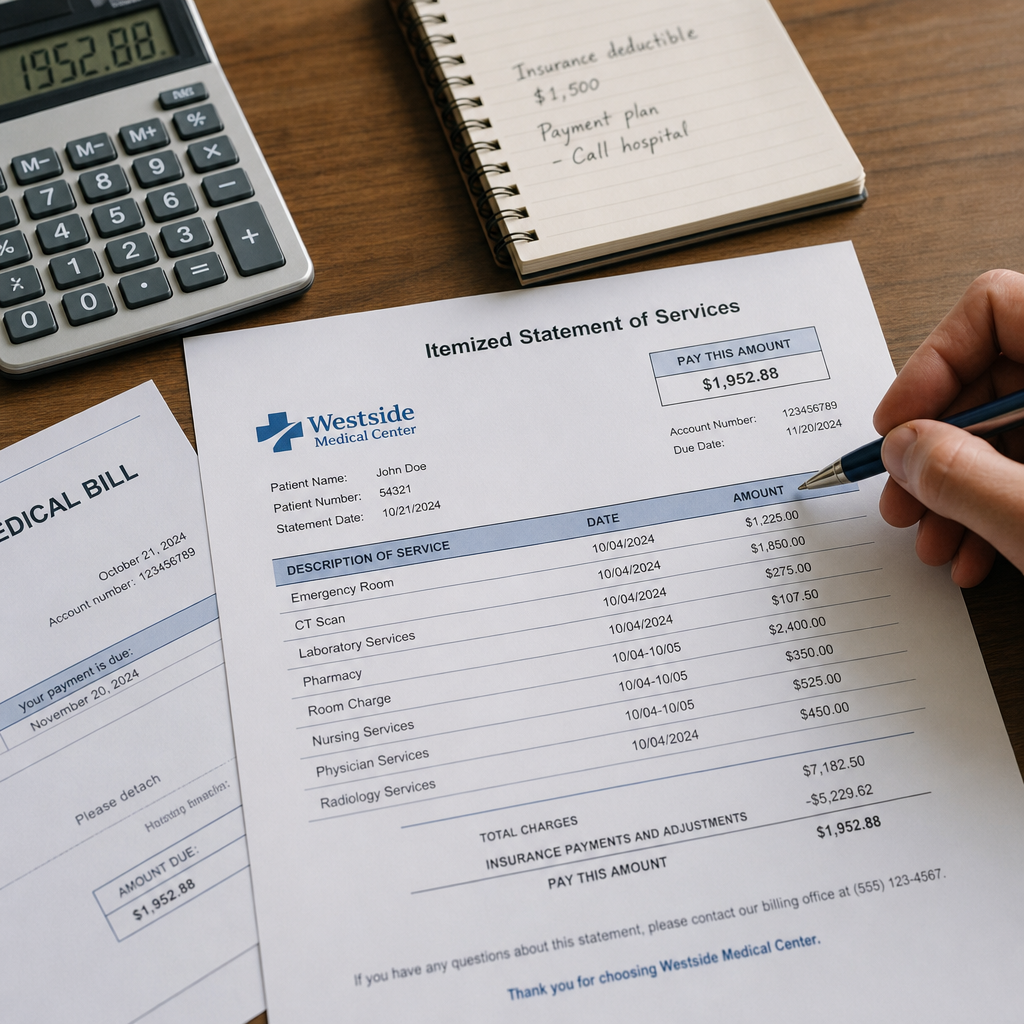
Before negotiating anything, request a detailed itemized bill (not just a summary statement). You have the legal right to this document. The itemized bill should include:
- Every procedure, test, and service with its CPT (procedure) code
- Each medication administered with quantity and unit price
- Room charges broken down by day
- Supplies and equipment charges
- Professional fees (doctor, anesthesiologist, radiologist, etc.)
Script for requesting itemized bill:
“I’d like to request a fully itemized bill with all CPT codes, descriptions, and individual charges. I want to review each line item before making any payment. Can you send this within 30 days?”
Step 2: Audit Your Bill for Errors
With your itemized bill in hand, check for these common errors:
| Error Type | What It Looks Like | How Common |
|---|---|---|
| Duplicate charges | Same procedure billed twice | Very common |
| Upcoding | Billed for more expensive procedure than performed | Common |
| Unbundling | Procedures that should be billed together charged separately | Common |
| Incorrect quantities | Wrong number of medications or supplies | Common |
| Wrong room rate | Charged for private room when in shared | Moderate |
| Phantom charges | Services or supplies never received | Moderate |
| Operating room time errors | Incorrect time billed for surgery suite | Moderate |
| Post-discharge charges | Charges after you left the hospital | Occasional |
Pro tip: Compare your itemized bill against your medical records. You can request your complete medical records under HIPAA. Cross-referencing the two documents reveals charges for services that aren’t documented in your records.
Step 3: Research Fair Prices
Before negotiating, arm yourself with data on what your procedures should cost. Use these resources:
- Healthcare Bluebook (healthcarebluebook.com): Shows “fair price” ranges for procedures in your area
- Medicare rates: Look up Medicare reimbursement rates for your procedures. Many negotiation experts recommend asking to pay 125-150% of Medicare rates, which is still far below typical chargemaster prices.
- Hospital price transparency tool: Since 2021, hospitals must publish their prices online. Look for your hospital’s “chargemaster” or “price transparency” page.
- Your insurer’s allowed amount: If you have insurance, your Explanation of Benefits (EOB) shows what your insurer considers reasonable for each service.
Step 4: Negotiate Your Bill
Strategy A: Self-Pay / Uninsured Discount
If you’re uninsured or your insurance didn’t cover the service, ask for a self-pay or prompt-pay discount. Many hospitals offer 20-50% discounts for self-pay patients who pay promptly.
Script:
“I’m a self-pay patient and I’d like to know about your self-pay discount. I’ve researched the fair market rates for these services and I’d like to propose paying [X amount], which is consistent with what insurance companies typically reimburse. I can pay this amount within 30 days if we can agree on a reduced total.”
Strategy B: Financial Hardship Assistance
If your income qualifies, most hospitals have financial assistance (charity care) programs. Nonprofit hospitals are required by law to offer them. These programs can reduce bills by 50-100%.
Typical income thresholds:
- Full write-off: Household income below 200% of Federal Poverty Level (~$62,400 for a family of 4 in 2026)
- Partial reduction: Household income 200-400% of FPL
- Sliding scale: Based on income and family size
Script:
“I’d like to apply for your hospital’s financial assistance program. I’m having difficulty paying this bill and my household income is [amount]. Can you send me the application? I understand the hospital has a charity care policy and I believe I may qualify for a reduction.”
Strategy C: Payment Plan Negotiation
If you can’t pay in full but don’t qualify for financial assistance, negotiate a zero-interest payment plan. Most providers prefer this to sending your bill to collections.
Script:
“I want to pay this bill but I can’t afford a lump sum. Can we set up a monthly payment plan? I can commit to [$ amount] per month. I’d like to confirm this arrangement won’t incur interest or be reported to credit bureaus as long as I maintain the agreed payments.”
Strategy D: Lump-Sum Settlement
For older bills or bills approaching collections, offer a lump-sum settlement for less than the total amount. This works especially well for bills that are 90+ days old.
Script:
“This bill has been outstanding for [X months] and I’m not in a position to pay the full amount. However, I can offer a one-time payment of [amount — typically 25-50% of the total] to settle this account in full today. Can we arrange that?”
Important: Always get settlement agreements in writing before making payment. Confirm the letter states the agreed amount settles the debt in full.
Step 5: Know Your Legal Protections
The No Surprises Act (2022)
This federal law protects you from:
- Surprise out-of-network bills: For emergency services at any facility
- Out-of-network charges at in-network facilities: You can’t be balance-billed by out-of-network providers at in-network hospitals (with some exceptions)
- Air ambulance surprise bills: Protected from out-of-network charges
If you receive a surprise bill that you believe violates this law, file a complaint at cms.gov/nosurprises.
Medical Debt and Credit Reports (2023 Changes)
Recent changes have significantly reduced the credit impact of medical debt:
- Medical debt under $500 no longer appears on credit reports
- Paid medical collections are removed from credit reports immediately
- Medical debt goes to collections only after a minimum 365-day waiting period
- FICO 9 and VantageScore 3.0+ weight medical collections less than other debt
State-Level Protections
Many states have additional protections. Check your state’s attorney general website for information on:
- Hospital lien laws (limits on how hospitals can collect)
- Wage garnishment protections for medical debt
- State-specific financial assistance requirements for hospitals
- Medical debt settlement laws
How to Lower Ongoing Healthcare Costs
Before Your Appointment
- Ask for the cost upfront. Call the billing department before any procedure to get a cost estimate.
- Verify network status. Confirm every provider involved in your care is in-network — including anesthesiologists, radiologists, and pathologists.
- Request generic medications. Ask your doctor to prescribe generics when available. Use GoodRx or RxSaver to compare pharmacy prices.
- Use telehealth when appropriate. Virtual visits typically cost $50-$100, compared to $150-$300+ for in-person visits.
For Prescriptions
- GoodRx: Compare prices across pharmacies and access discount coupons
- Mark Cuban’s Cost Plus Drugs: Transparent pricing at near-cost for many medications
- Patient assistance programs: Most pharmaceutical companies offer free or discounted medications for qualifying patients
- Mail-order pharmacies: Often 20-40% cheaper for 90-day supplies of maintenance medications
- Pill splitting: Ask your doctor if you can get a higher-dose pill and split it (many medications are the same price regardless of dose)
For Procedures and Tests
- Outpatient facilities vs. hospitals: The same procedure at an ambulatory surgery center can cost 50-70% less than at a hospital
- Independent imaging centers: MRIs and CT scans at independent centers cost 40-60% less than hospital imaging departments
- Cash pay rates: Some procedures are cheaper to pay cash than to run through insurance (especially with high-deductible plans)
When to Hire a Medical Billing Advocate
For bills over $10,000 or complex cases with multiple providers, consider hiring a professional medical billing advocate. These specialists:
- Audit your bill for errors (they often find 30-50% in overcharges)
- Negotiate with hospitals and providers on your behalf
- Navigate insurance appeals and denials
- Apply for financial assistance programs
Cost: Most billing advocates charge 25-35% of the savings they achieve, or a flat hourly fee ($100-$250/hour). For a $50,000 hospital bill with $15,000 in overcharges, even a 30% advocate fee ($4,500) saves you $10,500.
Find advocates through the Alliance of Claims Assistance Professionals (ACAP) or Medical Billing Advocates of America (MBAA).
Frequently Asked Questions
Can negotiating a medical bill hurt my credit score?
No. Negotiating directly with a provider does not affect your credit score. Medical bills only impact credit if they go to collections, and even then, the minimum waiting period is 365 days. Negotiating before that point has zero credit impact.
How much can I realistically reduce a medical bill?
Results vary, but typical reductions range from 20-60% of the original bill. Financial assistance programs at nonprofit hospitals can reduce bills by 50-100%. Self-pay discounts typically range from 20-50%.
What if the hospital refuses to negotiate?
If the billing department won’t budge, try: (1) Ask to speak with a supervisor or the patient financial services director, (2) File a complaint with your state insurance commissioner or attorney general, (3) Contact the hospital’s patient advocate or ombudsman, (4) Hire a medical billing advocate for complex cases.
Should I pay a medical bill with a credit card?
Generally no. Medical providers typically offer zero-interest payment plans, while credit cards charge 20%+ interest. If you must use a card, use a 0% APR credit card and pay off the balance before the promotional period ends.
Can medical debt be forgiven?
Yes, through financial assistance (charity care) programs, especially at nonprofit hospitals. Additionally, medical debt under $500 no longer appears on credit reports, effectively removing its financial sting. Some states and localities have passed medical debt relief programs.
What’s the difference between a medical bill and an Explanation of Benefits (EOB)?
An EOB is a statement from your insurance company showing what was billed, what they paid, and what you owe. It’s NOT a bill. Your actual bill comes from the provider. Always wait for the actual bill before paying — and compare it against the EOB for accuracy.
Medical Bill Negotiation Checklist
Use this checklist to ensure you don’t miss any savings opportunities:
- ☐ Request a fully itemized bill with CPT codes
- ☐ Request your complete medical records for the visit/stay
- ☐ Cross-reference the bill against your medical records for discrepancies
- ☐ Check for duplicate charges, upcoding, and unbundling
- ☐ Research fair prices using Healthcare Bluebook and Medicare rates
- ☐ Check the hospital’s published price transparency data
- ☐ Ask about self-pay / prompt-pay discounts
- ☐ Apply for the hospital’s financial assistance program
- ☐ Negotiate a zero-interest payment plan if needed
- ☐ If bill is 90+ days old, offer a lump-sum settlement
- ☐ Get all agreements in writing before making payment
- ☐ Check if the No Surprises Act applies to your situation
- ☐ Verify no bills have been sent to collections prematurely (365-day minimum)
- ☐ Consider hiring a billing advocate for bills over $10,000
Bottom Line
Medical bills are not final prices — they’re opening offers. By requesting itemized bills, auditing for errors, researching fair prices, and using the negotiation scripts in this guide, most patients can reduce their medical costs by 20-60%. Combined with financial assistance programs, payment plans, and new legal protections, you have more leverage than ever to manage healthcare costs.
Don’t let medical debt derail your financial progress. Take action promptly, know your rights, and don’t be afraid to negotiate. For related guidance, check our articles on medical debt rights and dealing with debt collectors.