
Disclosure: This article is for educational purposes only. Individual credit impacts vary based on your unique credit profile. Check your credit report for personalized insights.
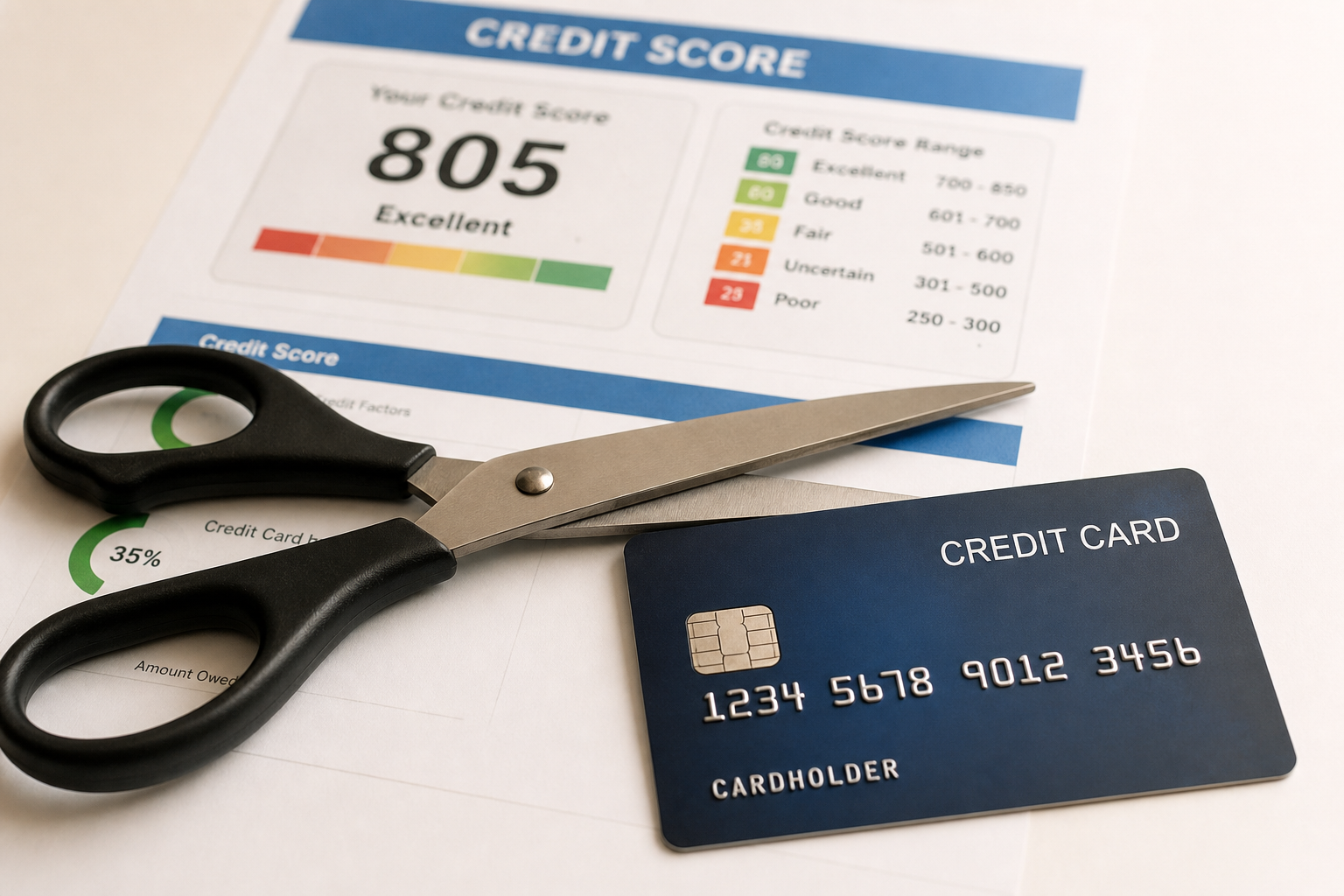
You’ve paid off a credit card and you’re tempted to close it — maybe to simplify your wallet, remove the temptation to spend, or ditch an annual fee. But before you call the issuer, you should know that closing a credit card can hurt your credit score in several ways — and the damage can be more significant than you’d expect.
The good news: closing a card doesn’t always tank your score, and sometimes it’s the right financial move despite the credit impact. In this guide, we’ll explain exactly how closing a card affects each factor of your credit score, when it makes sense to close one anyway, and smart alternatives that protect your score while achieving the same goal.
The Two Main Ways Closing a Card Hurts Your Score
1. It Increases Your Credit Utilization Ratio
Your credit utilization ratio — the percentage of available credit you’re using — accounts for about 30% of your FICO score. When you close a card, you lose that card’s credit limit from your available credit, which increases your utilization ratio.
Example:
| Scenario | Total Balances | Total Credit Limits | Utilization |
|---|---|---|---|
| Before closing | $3,000 | $20,000 (across 4 cards) | 15% ✅ |
| After closing a $5,000 limit card | $3,000 | $15,000 (across 3 cards) | 20% ⚠️ |
| After closing a $10,000 limit card | $3,000 | $10,000 (across 3 cards) | 30% ❌ |
The higher the credit limit of the closed card, the bigger the utilization hit. Closing a card with a $10,000 limit doubles utilization in this example — from a healthy 15% to a concerning 30%. For a deep dive on optimizing this metric, see our credit utilization guide.
2. It Can Reduce the Average Age of Your Accounts (Eventually)
The length of your credit history makes up about 15% of your FICO score. It includes the age of your oldest account, the age of your newest account, and the average age of all accounts. Here’s the nuance most articles get wrong:
Closed accounts don’t disappear from your credit report immediately. A closed account in good standing stays on your report for up to 10 years. During those 10 years, it continues to age and contribute to your average account age. The negative impact on account age only hits when the closed account eventually falls off your report.
However, some scoring models exclude closed accounts from the average age calculation right away. FICO models generally include them; VantageScore models are less consistent. The safest assumption: closing an old card will eventually reduce your average account age.
How Much Will Your Score Actually Drop?
The impact varies based on your overall credit profile, but here are general ranges:
| Situation | Expected Score Impact | Recovery Time |
|---|---|---|
| Closing a card with $0 balance, low limit, and you have many other cards | 0–10 points | 1–2 months |
| Closing a card with a high limit (increases utilization to 20%–30%) | 10–30 points | 2–6 months |
| Closing your oldest card with a high limit | 20–45 points | 6–12 months |
| Closing a card when you only have 1–2 other cards | 30–50+ points | 6–12+ months |
Key insight: The thinner your credit file (fewer accounts, shorter history), the bigger the impact of closing any single account.
Other Credit Score Factors Affected by Closing a Card
Credit Mix (10% of FICO Score)
Credit scoring models reward having a mix of account types — credit cards, installment loans, mortgages. If the card you’re closing is your only credit card and you have only installment loans remaining, your credit mix score could dip slightly.
Number of Accounts (Part of Credit Mix/New Credit)
Having more accounts generally helps your score (up to a point). Closing an account reduces the number of accounts on your profile, which can have a minor negative effect.
What Closing a Card Does NOT Affect
- Payment history: Your positive (or negative) payment history on a closed account remains on your credit report for up to 10 years. Closing a card doesn’t erase your track record.
- Hard inquiries: The inquiry from when you originally applied for the card stays on your report for 2 years regardless of whether the account is open or closed.
When It Makes Sense to Close a Credit Card
Despite the potential score impact, there are legitimate reasons to close a card:
1. High Annual Fee You Can’t Justify
If a card charges $95–$550/year in fees and you’re not using the benefits enough to justify the cost, closing it (or downgrading — see below) makes financial sense. Paying $450/year to protect a few credit score points is rarely worth it.
2. Spending Temptation
If having open credit lines leads to overspending and credit card debt, closing the card may be the right call for your overall financial health — even at the cost of a temporary score dip.
3. Divorce or Financial Separation
Joint credit cards or accounts where your ex-spouse is an authorized user should be closed to prevent future charges you’d be liable for. See our financial planning after divorce guide for the full checklist.
4. Fraudulent Activity or Security Concerns
If a card has been compromised and you don’t trust the issuer’s fraud resolution, closing and replacing the account is reasonable.
5. Simplification
If you have 8+ credit cards and managing them is a burden, strategically closing the least valuable ones (lowest limits, highest fees, fewest rewards) can simplify your finances without major credit impact — provided you keep your utilization in check.
Smart Alternatives to Closing a Credit Card
Before closing a card, consider these strategies that achieve similar goals with less credit score impact:
1. Downgrade to a No-Annual-Fee Version
Most issuers will let you “product change” to a different card in their lineup. For example, downgrade a Chase Sapphire Reserve ($550/year) to a Chase Freedom Unlimited ($0/year). You keep the account age and credit limit, eliminate the fee, and your score isn’t affected at all.
Call the number on the back of your card and ask: “Can I downgrade this card to a no-annual-fee version?” Our list of best no-annual-fee credit cards can help you identify good downgrade targets.
2. Ask for a Retention Offer
Before closing, call the issuer and say you’re considering canceling due to the annual fee. Many issuers will offer a “retention bonus” — statement credits, extra rewards points, or a reduced fee — to keep you as a customer. This is especially common with travel and premium cards.
3. Put a Small Recurring Charge on It
Instead of closing a card you rarely use, put a small recurring charge (Netflix, Spotify, a streaming service) on it and set up autopay. This keeps the account active, preserves your credit limit, and prevents the issuer from closing it for inactivity.
4. Lock the Card (Don’t Close It)
Most card issuers now let you “lock” or “freeze” your card through their app. This prevents new purchases while keeping the account open and preserving your credit limit. It’s a great option if you want to remove spending temptation without the credit score consequences.
5. Request a Credit Limit Increase on Another Card First
If you’re going to close a card, offset the utilization impact by requesting a credit limit increase on another card first. If your remaining cards have higher limits, the utilization hit from closing one card is minimized.
How to Close a Credit Card Properly (If You Decide To)
If you’ve weighed the pros and cons and decided to close the card, follow these steps to minimize negative effects:
- Pay off the balance completely. You can’t close a card with an outstanding balance at most issuers. Even if you can, the interest continues accruing.
- Redeem any remaining rewards. Check for unredeemed cash back, points, or miles. Some rewards expire when the account closes.
- Pay down balances on other cards first. Reduce your overall utilization before closing to offset the credit limit loss.
- Call the issuer to close the account. While some allow online closure, calling ensures the closure is processed correctly. Ask for written confirmation.
- Send a written confirmation request. Ask the issuer to send a letter confirming the account is “closed at consumer’s request” with a $0 balance. This protects you if there are disputes later.
- Check your credit report 30–60 days later. Verify the account shows as “closed by consumer” (not “closed by creditor,” which looks worse). Dispute any inaccuracies.
- Monitor your score. Watch for utilization-related dips and take corrective action if needed.
The Impact of Closing Your Oldest Credit Card
Closing your oldest card deserves special attention because it has the biggest potential impact on your average account age. Let’s say you have four cards:
- Card A: opened 15 years ago (oldest)
- Card B: opened 8 years ago
- Card C: opened 4 years ago
- Card D: opened 1 year ago
Average age with all four cards: (15 + 8 + 4 + 1) / 4 = 7 years
Average age after closing Card A: (8 + 4 + 1) / 3 = 4.3 years
That’s a drop from 7 years to 4.3 years — a significant hit to your credit history length. Remember, FICO keeps closed accounts in the age calculation for up to 10 years, so the immediate impact may be smaller. But 10 years from now, when Card A drops off, the reduction kicks in.
Our advice: Almost never close your oldest credit card. If it has an annual fee, downgrade it to a no-fee version. Protecting your oldest account is one of the simplest ways to maintain a strong credit profile.
Does Closing a Credit Card Affect Your Mortgage Application?
If you’re planning to apply for a mortgage in the next 6–12 months, avoid closing any credit cards. Mortgage lenders look closely at your credit utilization and score stability. A sudden score drop — even a temporary one — could cost you a higher interest rate or affect your approval.
Wait until after closing on your home to make any credit card changes.
What Happens to a Card You Never Use?
If you stop using a card but keep it open, the issuer may eventually close it for inactivity — typically after 12–24 months of no activity. This “issuer-initiated closure” has the same credit impact as you closing it yourself, but it looks slightly worse on your credit report (“closed by creditor” vs. “closed by consumer”).
To prevent this, make at least one small purchase every 6–12 months, or set up a small recurring charge with autopay.
Frequently Asked Questions
Will closing a credit card I never use hurt my score?
It can, primarily through utilization impact. Even if you never charge anything on the card, its credit limit counts toward your total available credit. Closing it removes that limit and increases your utilization ratio. If the card has no annual fee, there’s little reason to close it.
How long does the score drop last after closing a card?
The utilization-related impact shows up within 1–2 billing cycles and can recover within 2–6 months if you pay down other balances. The account-age impact is delayed — it won’t fully materialize until the closed account drops off your report in ~10 years.
Is it better to close a credit card or leave it open with a zero balance?
Leave it open with a zero balance — especially if it has no annual fee. An open card with a $0 balance helps your utilization, preserves your credit history, and contributes to your credit mix. There’s no downside to keeping a no-fee card open.
Can I reopen a closed credit card?
Sometimes. Some issuers allow you to reopen a recently closed account (usually within 30 days). After that, you’d need to apply for a new card, which means a hard inquiry and potentially different terms. It’s always easier to keep a card open than to reopen one.
Does closing a store credit card hurt more than closing a regular card?
The credit impact is the same regardless of card type. However, store cards often have low credit limits, so the utilization impact of closing one is usually smaller than closing a card with a $10,000+ limit.
Should I close a credit card I was an authorized user on?
If you’re an authorized user, you can simply ask the primary cardholder to remove you. This removes the account from your credit report entirely. If the account has a positive history, keeping it can help your score; if it has negatives (late payments, high balance), removal may help. See our authorized user guide for more.
The Bottom Line
Closing a credit card can hurt your credit score — mainly through increased utilization and (eventually) reduced credit history length. For most people, the best approach is to downgrade annual-fee cards to no-fee versions and keep zero-balance cards open with a small recurring charge.
However, credit scores are a tool, not a trophy. If closing a card removes spending temptation, eliminates a fee you can’t justify, or simplifies a messy financial situation, the temporary score dip may be worth the long-term financial benefit. Just time it right — avoid closing cards before a major loan application — and the impact will be manageable.
For more strategies to strengthen your credit profile, check out our guides on how to raise your credit score and building credit from scratch.